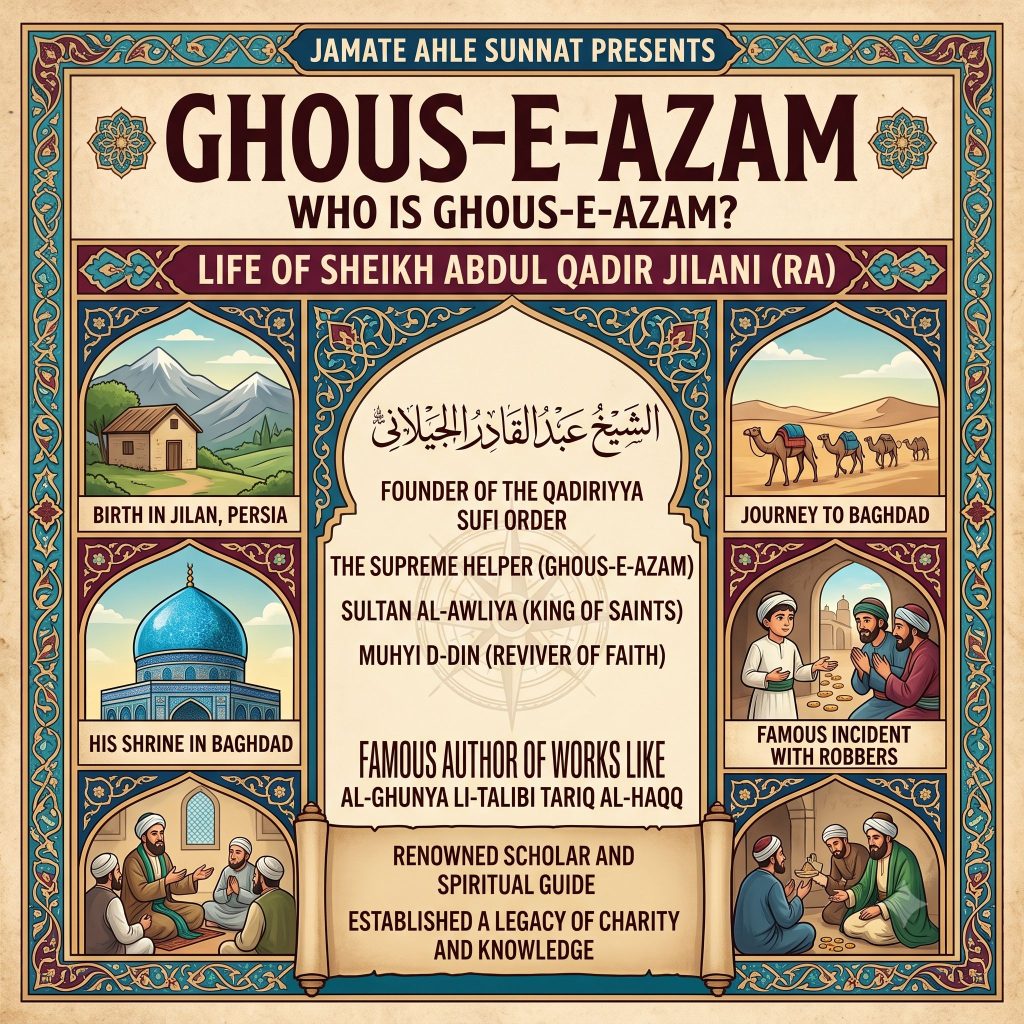
Sheikh Sayyid Abdul Qadir Jilani (RA) (470–561 AH / 1077–1166 CE), known across India as Ghous-e-Azam, Ghaus Pak, Muhyuddin and Mahboob-e-Subhani, was a Hanbali jurist, preacher and spiritual guide of Baghdad and the eponym of the Qadiri order. Here is his life in order: birth and lineage, his years of study, the long seclusion, his work in Baghdad, his books, and what his life teaches us today, with the sources and with careful notes on which stories are well documented and which are traditional.
In brief
- He was born in Jilan in 470 AH and travelled to Baghdad at about 18 to study; he died there in 561 AH.
- He was first a jurist and hadith student, then a spiritual guide: knowledge came before the path of the heart.
- His public sermons drew very large crowds; his books Ghunyat al-Talibin and Futuh al-Ghayb are still read.
- Some popular stories about him come from later biographers; good scholarship separates them from the well-attested facts.
Life timeline at a glance
- 470 AH (1077 CE)Born in Jilan.
- 488 AH (1095 CE)Leaves for Baghdad to study, aged about 18.
- Around 490–521 AHStudies fiqh, hadith, tafsir and Arabic; follows the path of tasawwuf; spends years in seclusion in Iraq.
- 521 AH (1127 CE)Returns to Baghdad and begins public teaching.
- 528 AHTakes charge of the madrasa and hospice (ribat) built around him.
- 545–546 AHDelivers the sermons compiled as al-Fath al-Rabbani.
- 561 AH (1166 CE)Passes away on 11 Rabi al-Thani.
Birth and noble lineage
He was born on 1 Ramadan 470 AH (1077 CE) in Jilan (Gilan), south of the Caspian Sea, in present-day Iran. His father was Abu Salih Musa Jangi Dost (RA), his mother Umm al-Khayr Fatima (RA), a pious woman who is remembered for her role in his upbringing.
According to his biographers, he was a Hasani-Husayni Sayyid: a descendant of Imam Hasan (RA) through his father and of Imam Husain (RA) through his mother, hence a descendant of the Prophet ﷺ from both sides. This lineage is recorded in traditional biographies such as Bahjat al-Asrar, and it is a reason the Ummah honours him.
Childhood and his mother’s teaching
Traditional narrations: His biographers report signs of sainthood from birth, for example that as an infant he would not nurse during the fasting hours of Ramadan. Such stories come mainly from later sources; treat them as expressions of love from his followers rather than as firmly documented history.
He grew up in a devout household. A well-known account, repeated in the traditional biographies, says his father died early, that his mother raised him, and that she sent him to Baghdad with the advice to always speak the truth, a lesson that shaped the rest of his life.
Student years in Baghdad
In 488 AH, at about eighteen, he reached Baghdad, then the capital of the Abbasid caliphate and the centre of Islamic learning. He studied:
- Fiqh: mainly Hanbali law, under teachers such as Abu Sa’d al-Mubarak al-Mukharrimi and Abu al-Wafa Ali ibn Aqil.
- Hadith: under scholars including Abu Muhammad Ja’far ibn Ahmad al-Sarraj.
- Tafsir, Arabic language and literature, and usul (the principles of religion and law).
- Tasawwuf: under Sheikh Hammad al-Dabbas (RA); the spiritual cloak (khirqa) reached him through al-Mukharrimi.
Ibn Rajab al-Hanbali records that he issued fatwas according to both the Hanbali and Shafi’i schools. He did not come to Sufism as a substitute for scholarship but as a scholar who looked for the purification of the heart, the same idea behind tasawwuf in Ahl al-Sunnah.
Twenty-five years of seclusion
After his studies he is reported to have spent nearly twenty-five years in worship and self-discipline in the deserts and ruins of Iraq: fasting, night prayer, and struggle against the ego (nafs). This period, called mujahada, is the basis of the Sufi teaching that real spiritual progress comes through effort, not shortcuts.
The aim of this seclusion was not to abandon the world or the Sunnah but to empty the heart of everything except Allah so that service to people would be sincere. His biographers say that he returned to public life after receiving inner instruction to do so.
Return and the great public sermons
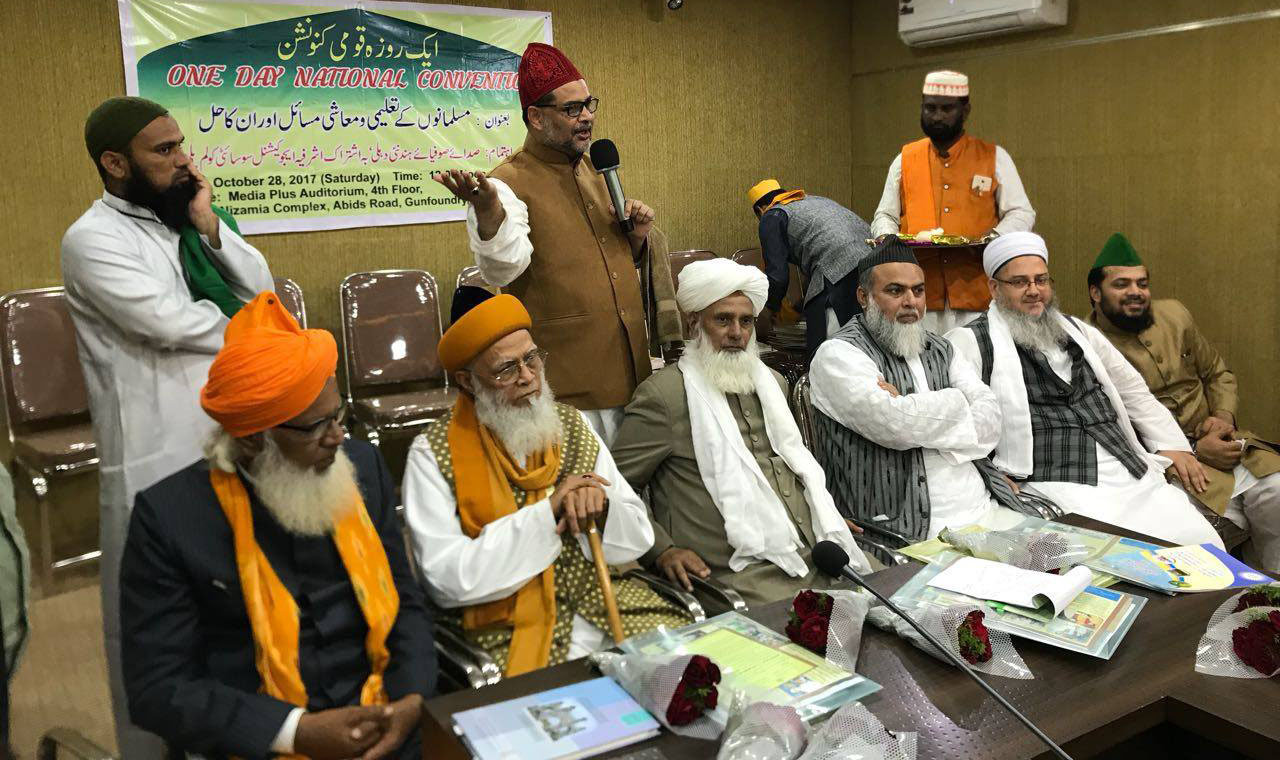
Around 521 AH (1127 CE), aged about fifty, he returned to Baghdad and began to teach in public. The madrasa of his teacher al-Mukharrimi (in the Bab al-Azaj quarter) was handed over to him, and it grew into a school with a hospice; its expansion was completed around 528 AH.
His daily routine, as reported, combined teaching tafsir, hadith, fiqh and tasawwuf, giving fatwas to questioners from across the Muslim world, feeding the poor, fasting by day and praying at night. He preached publicly several times a week, including Friday mornings and Tuesday evenings. Traditional accounts describe audiences of many thousands, including judges, scholars and ordinary people, and say that large numbers repented and that many non-Muslims embraced Islam at his gatherings; exact figures like “a hundred thousand” come from later reports and should be read as expressions of the scale of his influence.
The themes of his sermons were direct: repent from sins, earn halal, pray with presence of heart, love the Prophet ﷺ, serve people, and prepare for death. Many Indian Muslims also remember him when seeking a means (waseela) to Allah; for the Ahl al-Sunnah view on that, read what is tawassul.
His books
- Ghunyat al-Talibin (Provision for the Seekers): a manual of belief, worship, etiquette and spirituality.
- Futuh al-Ghayb (Revelations of the Unseen): 78 discourses on repentance, trust in Allah and sincerity.
- Al-Fath al-Rabbani (The Sublime Revelation): 62 sermons delivered in 545–546 AH.
- Jala al-Khawatir: discourses on purifying the heart.
- Sirr al-Asrar: attributed to him, though some scholars question its authenticity.
His sons, including Abd al-Razzaq and Abd al-Aziz, were themselves scholars and carried on his teaching, and his students spread his method across the Muslim world. Separate articles will cover each book: Ghunyat al-Talibin, Futuh al-Ghayb and Al-Fath al-Rabbani.
Passing away and Gyarvi Sharif
He passed away in Baghdad on 11 Rabi al-Thani 561 AH (1166 CE) at about ninety years of age. His shrine in Baghdad is visited throughout the year. In India and across South Asia, his lovers remember him on the 11th of every month with Gyarvi Sharif and on 11 Rabi al-Thani with his annual Urs, through Quran recitation, naat, dhikr and feeding the poor. Read more in Gyarvi Sharif: meaning and method.
Sources: what is firm, what is traditional
Good history separates the well-attested from the embellished. Early and reliable sources on his life include:
- Ibn Rajab al-Hanbali, Dhayl Tabaqat al-Hanabila: a Hanbali biography that also notes that some popular stories about him are exaggerated.
- Imam al-Dhahabi, Siyar A’lam al-Nubala: praises him as a leading imam, jurist and ascetic, while cautioning against weak narrations about his miracles.
- Ibn Kathir, al-Bidaya wa al-Nihaya: records his death in the events of 561 AH and describes his position in Baghdad.
- Al-Shattanawfi, Bahjat al-Asrar: the main source for his karamat (saintly miracles), valued in the Qadiri tradition but mixing stronger and weaker reports.
A word on citations: verify any quotation attributed to a named scholar in the book and page before reproducing it. Several popular sayings praising Ghous-e-Azam (for example, one widely attributed to Imam al-Nawawi about the mass-transmitted reports of his karamat) are attributed to different people in different books. The safest way is to cite the source book directly.
Lessons for Indian Muslims today
- Knowledge with action: he mastered the law and then worked on the heart.
- Courage in truth: he spoke against wrong in an age of luxury and sectarianism.
- Service: he fed the poor and taught the ignorant for free.
- Truthfulness: the promise of honesty he made to his mother defined his life.
This is also the message of Jamat Ahle Sunnat Karnataka (JASK): firm on Aqeedah and Shariah, full of love for all.
Frequently asked questions
When was Ghous-e-Azam born?
On 1 Ramadan 470 AH (1077 CE) in Jilan. A few sources give 471 AH.
When did he pass away?
On 11 Rabi al-Thani 561 AH (1166 CE) in Baghdad.
Did he found the Qadiri order himself?
The order is named after him and was organised by his sons and students after his death. He is regarded as its spiritual source.
Which school of fiqh did he follow?
The Hanbali school, though he gave fatwas according to the Shafi’i school as well and respected all four schools.
Why is he called Ghous-e-Azam and Muhyuddin?
Ghous-e-Azam (“the Greatest Helper”) and Muhyuddin (“reviver of the religion”) are titles of love given by the community; Mahboob-e-Subhani means “beloved of the Divine”.
What is Gyarvi Sharif?
A South Asian custom of remembering him on the 11th of each month with Quran, naat, dhikr and langar. See Gyarvi Sharif.
Keep reading
To love the awliya is to follow their example: seek knowledge, purify the heart, and serve the creation of Allah.
- Ibn Rajab, Dhayl Tabaqat al-Hanabila
- al-Dhahabi, Siyar A’lam al-Nubala
- Ibn Kathir, al-Bidaya wa al-Nihaya
- al-Shattanawfi, Bahjat al-Asrar
- Abd al-Qadir al-Jilani, Ghunyat al-Talibin, Futuh al-Ghayb, al-Fath al-Rabbani